
By IAN WILSON
He wasn’t here for long, but Bert Blyleven did appear to have a good time during his stays in Western Canada.
The Hall of Fame pitcher – who made two starts for the Edmonton Trappers in 1992 – experienced a home coming of sorts during his rehab assignment.
Born in Zeist in the Netherlands, Blyleven lived in Saskatchewan in the 1950s when his family immigrated to North America and sought more permanent residence in the United States.
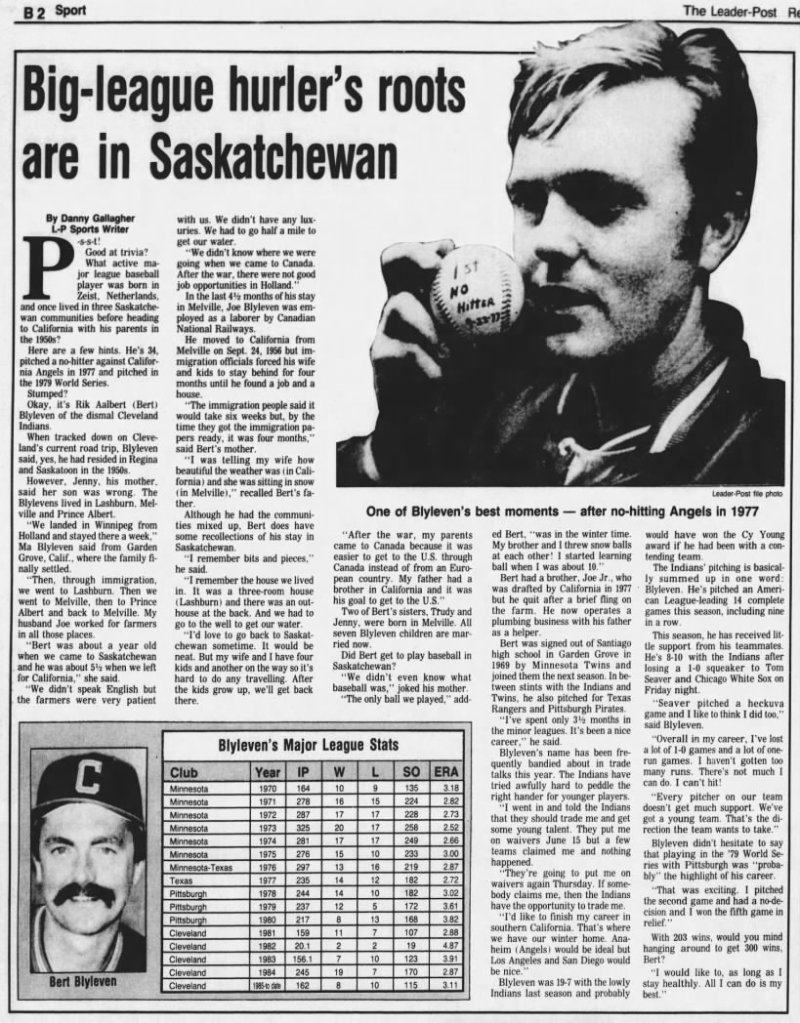
His time in Saskatchewan was documented in a Regina Leader-Post newspaper article written by journalist Dan Gallagher.
“We landed in Winnipeg from Holland and stayed there a week,” said Blyleven’s mother Jenny in the story, which was published on July 24, 1985.
“Then, through immigration, we went to Lashburn. Then we went to Melville, then to Prince Albert and back to Melville. My husband Joe worked for farmers in all those places. Bert was about a year old when we came to Saskatchewan and he was about five-and-a-half when we left for California.”
Jenny said the family didn’t speak English at the time, but the farmers were patient in communicating with them.
“We didn’t have any luxuries. We had to go half a mile to go get our water. We didn’t know where we were going when we came to Canada. After the war there were not good job opportunities in Holland,” she recalled.
Joe eventually landed work as a labourer with Canadian National (CN) Railway before moving from Melville to California in September of 1956. The rest of the family remained in Saskatchewan while he looked for employment and housing in the U.S.
“The immigration people said it would take six weeks but, by the time they got the immigration papers ready, it was four months,” Jenny said in the Leader-Post article.
Bert, who is one of seven children, also shared recollections of his time in Canada.
“I remember bits and pieces … I remember the house we lived in. It was a three-room house (in Lashburn) and there was an outhouse at the back. And we had to go to the well to get our water,” said the junior Blyleven, who mused about a return trip to Saskatchewan.
“After the war, my parents came to Canada because it was easier to get to the U.S. through Canada instead of from an European country. My father had a brother in California and it was his goal to get to the U.S.”
Two of Bert’s sisters – Trudy and Jenny – were born in Melville.
As for sports, Blyleven didn’t know anything about baseball and they didn’t play it in Saskatchewan.
“The only ball we played was in the winter time,” he told Gallagher.
“My brother and I threw snowballs at each other. I started learning ball when I was about ten.”
ALBERTA BOUND
Fast-forward to May of 1992 and Blyleven was back in Western Canada, although this time he was in Saskatchewan’s neighbouring province of Alberta.
The third-round pick of the Minnesota Twins was attempting a comeback from rotator cuff surgery when he arrived in Alberta.
After losing more than a full year to the shoulder injury, Blyleven began the campaign with the Double-A Midland Angels of the Texas League. In five April starts, the righthander went 2-3 with a 2.73 earned run average (ERA) and 23 strikeouts through 33 innings. The performance earned him a promotion to the Pacific Coast League (PCL), where the California Angels were eager to see how much the 41-year-old had left in the tank.
His first start for the Edmonton Trappers came at Foothills Stadium on May 8th in Calgary, where he lined up against another veteran pitcher, Andy Hawkins, who was in the midst of his final season of professional baseball with the Cannons.
“I’m determined to make it back,” Blyleven told Calgary Herald reporter Daryl Slade.
“If California doesn’t have any room for me, then other clubs need pitching.”
In his first Triple-A start since 1970, the two-time World Series champion pitched six strong innings in baseball’s Battle of Alberta, allowing five hits, one run and two walks while striking out five batters. The effort paced Edmonton to a 5-2 win over Calgary.
“I take more pride in my pitching now than maybe when I was younger … but I don’t really stay up all night and say I’m gonna get this guy or that guy,” Blyleven told the Herald.
PLENTY TO PLAY FOR
While it may have seemed odd for some fans to see a guy with 21 MLB seasons and a no-hitter under his belt trying to get back to the big leagues, the 1985 American League (AL) strikeout leader still had plenty to prove.
“Really, I think it’s a lot of determination, a lot of desire. I have some goals I’d like to achieve,” Blyleven told Slade.
He was just nine strikeouts behind Tom Seaver at the time and he was chasing down some lofty MLB benchmarks, including 5,000 innings pitched and 300 career victories. Blyleven did ultimately surpass Seaver – he currently sits fifth on the list of all-time strikeout leaders with 3,701, but he fell a bit short in the other categories, finishing with 4,970 innings (still good for 14th overall among major-league pitchers) and 287 wins.
“I guess all those things keep me driving, but it’s just the inner drive I have to want to be on the hill and compete. It’s fun. Personal things are nice, as long as you keep that team concept in hand,” said Blyleven at the time.
One of his opponents at Foothills Stadium, Calgary outfielder John Moses, played with Blyleven as a member of the Twins in 1988.
“He was a great guy to have in the clubhouse,” said Moses, who drove in a run with a single in the fifth inning.
“When he wasn’t pitching, you never knew what to expect. He was such a practical joker. But when it was his turn to pitch, he’d give you everything. He’s a very hard worker.”
DOUBLE TROUBLE
After his impressive Cowtown outing, Blyleven had a home date with the Edmonton fans at John Ducey Park on May 13th. He toed the rubber in the first game of a Wednesday doubleheader against the Portland Beavers.
Blyleven proved victorious again, but in far less convincing fashion. Over 5.2 innings, he threw 85 pitches and 11 of them were pounded back for hits, including a home run by first baseman Rob Nelson in the second inning. The Beavers got to Blyleven again in the fourth frame when a triple by Chip Hale and a double by Bernardo Brito helped produce four runs. The final result was an 11-7 Edmonton win in front of 1,481 fans, with Blyleven surrendering all seven earned runs. He also walked a pair of hitters and struck out two batters.
“You don’t want your career to end, you want it to go on forever,” Blyleven told Edmonton Journal writer Robin Brownlee after the game.
“It’s something that, well, it’s the greatest job in the world, something I dreamed about as a kid. To be able to play as long as I have is great. I love the sport of baseball. How long do I have left? I have to get back first.”
He continued to plead his case to Brownlee.
“Hopefully, I’ve convinced them I’m ready to pitch in a major-league game. It’s up to them,” said Blyleven, who was born in the town of Zeist in the central Netherlands.
“I’m fortunate I’ve played 21 years in the big leagues. I know what it takes to win in the big leagues. I would not say this if I felt I was going to go up and embarrass myself. I feel I’m ready.”
Trapper teammate Ken Oberkfell also thought Blyleven was prepared to take his game to the next level.
“I think he’s ready to go back. He can pitch in the big leagues again,” said the infielder, who would later join the illustrious pitcher that season on the Angels roster.
Oberkfell, who stepped into the batter’s box against the 6-foot-3 moundsman several times during his 19-year MLB career, also recalled what Blyleven’s curveball was capable of doing to opposing hitters.
“I saw one of the ugliest swings I’ve ever seen with him pitching, but it wasn’t me,” Oberkfell pointed out.
“It was Terry Kennedy in Pittsburgh. Bert threw a curveball that looked like it was over Terry’s head. Then it broke right down. Terry made kind of a karate chop at it. I remember that pitch. I remember that and his control … he’s still got that breaking ball.”
Blyleven didn’t have to wait long for the call he wanted. Less than an hour after collecting his second win with the Trappers, the Angels invited him to join the team in Boston and then make his first MLB start of 1992 against the New York Yankees.
PUCK WATCHING
He had made the most of his time in Edmonton, even managing to attend a National Hockey League (NHL) Game 6 playoff matchup between the Oilers and the Vancouver Canucks. Goaltender Bill Ranford blanked the Canucks while Craig MacTavish, Vincent Damphousse and Esa Tikkanen provided the scoring in a 3-0 Smythe Division series clinching win for the Oilers at Northlands Coliseum.
John Short, a columnist for the Journal, caught up with Blyleven at the hockey game, where the short-term Trapper was signing autographs, shaking hands and talking baseball with fans.
“It was class. Most impressive was that he didn’t have to do anything of the sort. I’m convinced many major leaguers would not have made themselves available,” Short observed.
“It must be evident that this man is the most prominent baseball personage ever to decorate decrepit old John Ducey Park during Edmonton’s PCL history.”
During their conversation, Blyleven reiterated his passion for baseball and his belief that he still had MLB-calibre stuff.
“I love everything about the game of baseball,” he told Short. “I believe I was given a gift to throw a baseball. As long as I can do it well, I’ll keep doing it.”
The two also discussed the superstar pitcher’s early years living in Saskatchewan.
“I remember Saskatchewan,” he said. “Not a great deal, but some.”
MOVING ON
With his bags packed and Blyleven shipping up to Boston, details of his new contract with the Angels emerged. The California team, owned by cowboy crooner Gene Autry, gave him a base salary of $300,000 with the ability to earn another $900,000 in bonuses.
His final numbers in Edmonton included a 2-0 record, 6.17 ERA, 7 Ks and three walks through 11.2 innings of work.
More importantly, Blyleven believed he was getting the opportunity he deserved.
“If it works out, great. If it doesn’t I know deep down I gave it all I had … that’s all I can expect of myself. I didn’t want to look four or five years down the line and wonder, what if I had tried?” he told the Journal.
Blyleven didn’t have to wonder any longer. He pitched another 133 innings for the Angels that year. It was far from vintage Blyleven, but he was a solid addition to California’s rotation, putting together an 8-12 record, with a 4.74 ERA and 70 strikeouts.
That was it for Blyleven’s playing days, but a successful broadcasting career with the Twins followed, as did a trip to Cooperstown, New York in 2011.




 Tales of Baseball