By IAN WILSON
He had already earned the title “Mr. Hockey” for his work on the ice.
But Gordie Howe easily could’ve added the nickname “The Natural” for how he competed on the ball diamond, at the golf course and even in the bowling alley.
Such was the immense talent of the man who had broad enough shoulders to carry such accomplishments.
Some of the stories associated with his time in baseball are as legendary as his exploits at the rink.
After joining the National Hockey League’s Detroit Red Wings in 1946, Howe dominated hockey. He remained with the Red Wings through 1971 and during his time in Motown he collected six Hart Trophies as the NHL’s most valuable player, and another half dozen Art Ross Trophies, which are given to the league’s leading point getter. He also helped the Wings win four Stanley Cups between 1950 and 1955.
In the early stages of his Hall-of-Fame hockey career, you could find Howe back home in Saskatoon at the ball diamond.
It was a continuation of the multi-sports approach Howe adopted as a child.
“I had a lot of friends when I was a kid, and we did everything together. We went from hockey, to football, to soccer, and then to baseball. We all loved playing baseball together,” he recalled in his authorized autobiography, entitled and … Howe!
“One day, we were playing, dressed in whatever clothes we had because we didn’t have any kind of uniforms. Two cars pulled up, and ten or eleven kids jumped out. And we thought, oh hell, look at this. They looked so nice. They had all these nice shirts, and real gloves and everything. And this one guy said to us, ‘Do you guys want to play?’ I said, ‘Yeah, we’ll play.’ We kicked the living hell out of them. We had some really fine ballplayers.”
Added Howe: “Somebody who was there watching us play came over and talked to us, and they got us uniforms with pullover shirts, and we put the initials of our school on them. So that’s how we got started as ballplayers.”
He played for a number of local baseball and softball teams on several different circuits in the late 1940s and early 1950s – Saskatoon Legion, the Olympics, the Dorns, the 55’s and the Gems – and helped them win some big-money tournaments across Alberta and Saskatchewan. When he wasn’t swinging a bat or chasing down ground balls, Howe also took on umpiring duties from time to time.
Author Roy MacSkimming, who wrote an unauthorized biography of Howe in 1994, described the baseball scene from that era.
“Both softball and baseball were big draws in Saskatchewan in the 1940s and ’50s. Major-league scouts used to say the calibre of western Canada semi-pro baseball was equivalent to that of double-A in the States. Small Saskatchewan towns such as Delisle, Rosetown and North Battleford, as well as the larger centres, fielded strong teams of local ballplayers supplemented by American imports, some of them recruited from the Black leagues in the midwest. In addition to their league schedules, Saskatchewan teams competed for prize money offered by numerous tournaments throughout the province, such as the annual Dominion Day tournament held at the old Cairns Field (now gone) … in Saskatoon,” wrote MacSkimming in Gordie: A Hockey Legend.
“For several summers, Howe was a familiar figure on the base paths at Cairns Field. It was a comfortable, roofed ballpark that could normally seat up to 5,000, but the July 1 tournament drew as many as 10,000 spectators, jamming the stands and extra bleachers and ringing the outfield. Baseball and softball tournaments were major local attractions in the days before television kept people at home and before cars, motor homes and cottages took them out of town for summer holidays. Howe had been playing ball since his school days; he’d once pitched for the King George softball team in the city finals. In semi-pro baseball, he played first base and sometimes third and was one of the most powerful and consistent hitters.”
A number of NHL players joined Howe on the diamonds in Saskatchewan in those days, including Bert Olmstead, Emile Francis, and the Bentley brothers, Max, Doug and Reg.
Vic Howe, who played 33 games with the New York Rangers in the 1950s, would also join forces with his brother at the ballpark on occasion.
One tall tale involving Gordie Howe credits him with producing the longest home run ever hit out of Cairns Field.
“The Canadian Pacific Railway tracks ran right behind the ballpark; one day Howe, playing baseball for Saskatoon, drove a towering home run over the right-field fence. The ball landed on a moving CPR flatcar and didn’t stop until it reached the town of Unity, eighty miles to the west. Of course, over the years the tale has grown taller, with the train not stopping until Calgary, or even Vancouver,” wrote MacSkimming of the legendary yarn that mimics a similar story involving Babe Ruth.
It was a story that long-time Saskatoon Star-Phoenix sports columnist Ned Powers loved to share with people.
Mr. Hockey did, however, participate in a much more verifiable diamond oddity during the 1948 senior league softball season in Saskatoon. On opening night in mid-May, pitcher Jimmy Cotts recorded 14 strikeouts on his way to tossing a no-hitter. Howe was playing first base during that game and he registered no putouts, no assists and no errors. Only two balls were hit to the outfield during the Olympics win over the Empires, while the lone runner to face Cotts and get to first base arrived via walk. It was a slow night in the field for Howe and his teammates.
Howe – who finished fifth in the league’s most valuable player voting that year – showed off his own pitching prowess later in the summer, when he surrendered just two hits in leading the Olympics to a 5-3 victory over the Osler Monarchs in late July.
When the softball season wrapped up, Howe led the circuit in stolen bases, with five, and he had a .324 batting average over 74 at bats. He scored 14 runs, produced nine RBI and two of his 24 hits were homers.
Howe finished off his summer at the ball diamond with a charity softball game at Cairns Field in early September. The contest pitted members of the NHL’s Detroit Red Wings against the Saskatoon Merchants. Joining Howe on the Detroit side were Calder Memorial Trophy winner Jimmy McFadden, Hockey Hall of Fame defenceman Jack Stewart, Vezina Tropy-winning goaltender Terry Sawchuk, and forward Max McNab.
In 1949, Howe helped lead his Dorns softball team to a city championship, along with a provincial title, and he finished second in Saskatoon Senior Men’s Softball League MVP voting after batting .378 and playing error-free ball at first base.
Howe had settled into a consistent routine of hockey-filled winters in Detroit and baseball-brimming summers in Saskatoon.
But the hard-hitting NHL playoffs in 1950 threatened to disrupt the balance of sporting pursuits he had in place. Howe required brain surgery after a collision with Ted Kennedy, a centre with the Toronto Maple Leafs, that sent him crashing into the boards during the semifinals. The violent impact of the encounter left Howe with a broken nose, fractured cheekbone, lacerated eyeball and hemorrhaging of the brain.
It was a scary and life-threatening injury, but Howe didn’t want his road to recovery to interfere with his time at the ball diamond.
“Gradually, he was able to return to his summertime pursuits – baseball, fishing, golf. In those days, it was baseball that Howe loved most. It was considerably less punishing than hockey, and it gave him the chance to test his recovery and rebuild his strength before the new NHL season began,” wrote MacSkimming.
Howe returned to playing both softball with the Dorns and baseball with the Saskatoon Legion in the Northern Saskatchewan Baseball League. In nine games for the Dorns, Howe belted three homers and batted .286. He added several more round trippers with the Legion and during exhibition play. Mixed in with the newspaper reports of his time at Cairns Field were articles of Howe’s exploits playing soccer and swinging clubs on the golf course. If he was suffering any ill effects from his hockey injury, they didn’t appear to be on display.
BASEBALL BOOM
The 1951 season brought a new level of excitement to baseball fans in the form of the newly-created Western Canada League, which had teams in Indian Head, Regina, Medicine Hat, Moose Jaw, Estevan and Swift Current.
Meanwhile, the upstart Saskatoon 55’s, a team that was formed by combining players from the Legion and the Cubs, did battle with Howe on the roster in the Northern Saskatchewan League.
The 55’s put together a heavy schedule comprised of several exhibition matchups. Manitoba baseball boosters were hopeful Saskatoon would visit their provincial capital. Ralph Mabee – the manager of the 55’s – was quoted in the Star-Phoenix about the interest shown by Winnipeg.
“If you have Gordie Howe in your lineup we’ll sell 10,000 tickets for a single performance,” Mabee was told.
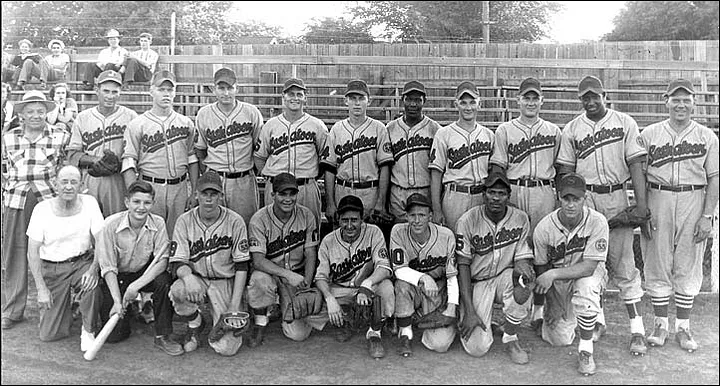
One of Howe’s highlights during the season was a 450-foot, inside-the-park home run during an 11-1 romp over the Colonsay Monarchs in July.
At the end of that month, the 55’s traveled to Renfrew Park in Edmonton for an eventful three-game series against the Oilers, which drew a weeknight crowd of 5,000 spectators.
The festivities included a golf display by Canadian Golf Hall of Famer Henry Martell, as well as a number of baseball skills competitions. Howe was crowned the long-distance throwing champion. According to a report in the Star-Phoenix, Howe didn’t even realize he was competing in the event, which earned him first-place prize money of five dollars.
“He didn’t know he was in the competition,” read the account in the July 31st edition of the newspaper.
“Fooling around with a ball in the outfield, Gordie saw someone wave at him from the general vicinity of the plate … he thought the chap wanted the ball, so took a couple of steps and let go … it was a near-perfect strike to the catcher at the plate and won Gordie first prize for the effort.”
That same article said Howe held his own against Martell, who was teeing up golf balls from home plate.
“A member of the 55’s slipped up and said they had a pretty fair golfer in their ranks – Gordie Howe,” noted the story.
“Martell immediately summoned Howe and gave him a golf club in exchange for a baseball bat … Howe didn’t tee up his first shot and it wasn’t so good, but Martell then tossed him a tee and boom!!! Gordie blasted a shot farther than any Martell had made.”
Along with the good times, Charlie Beene – a California pitcher who played with Howe on the 1951 Saskatoon 55’s – recalled the no-nonsense attitude that his teammate displayed during a lengthy road trip that summer.
““He rode in the car with our coach (Roy Taylor) from Visalia, California, and me and Bob Garcia and Jack Hannah, and what do guys do when they’re going 300 miles on a gravel road, and we’re in the back seat, and Gordie and the coach are in the front seat? Well, I don’t know if you know, but 17-year-olds, you slap the guy in the back of the head and then act like nothing happened,” said Beene in a Battlefords Now article.
“Well, that’s what we did with Gordie. Two or three times, me or Bob Garcia, my buddy, slapped him and finally he says, ‘Roy, stop the car. We’re going to settle this right now.’ We stopped by an overpass of a creek bed. Out of the car, and I said, ‘well Bob, I’m pretty tall, I’ll take him upper you take him lower and we can take him.’”
The youngsters attack strategy did not go as planned.
“So there we go, whaling away, down about a 20-foot bank, into the creek,” Beene said.
“We’re whaling away and we get to the bottom, all three of us sitting there, Bob Garcia says, ‘Look at that. Charlie’s got a bloody nose, Gordie’s got a bloody nose, and I don’t have one.’ With that, Gordie whopped him one with his big hockey hand, and he says, ‘You do now.’”
Despite the tussle, Beene considered Howe a “super guy.”
The two reconnected in 1993 and looked over scrapbooks of their baseball days from decades past.
“I really like him,” said Beene, who signed on with the Pittsburgh Pirates organization after playing with the 55’s.
“You got what I consider one of the nicest, greatest players and nicest men in the world in Gordie Howe.”
ALL GOOD THINGS
As much fun as Howe was having clubbing homers and stealing bases, the good times at Saskatoon ballparks eventually came to an end, or at very least, attempts were made to keep his extra-curricular activities in check.
In 1952, Howe was at the height of his hockey powers. He was coming off an NHL season that saw him claim an Art Ross Trophy, Hart Memorial Trophy, and a Stanley Cup, the Wings second in three years.
Howe headed home to Saskatchewan in the offseason, but he had already informed Taylor, the coach of the 55’s, about his plan to scale back his baseball activities.
“Gordie says he will not play baseball this year. Wants to do more fishing,” Taylor told the Star-Phoenix in March.
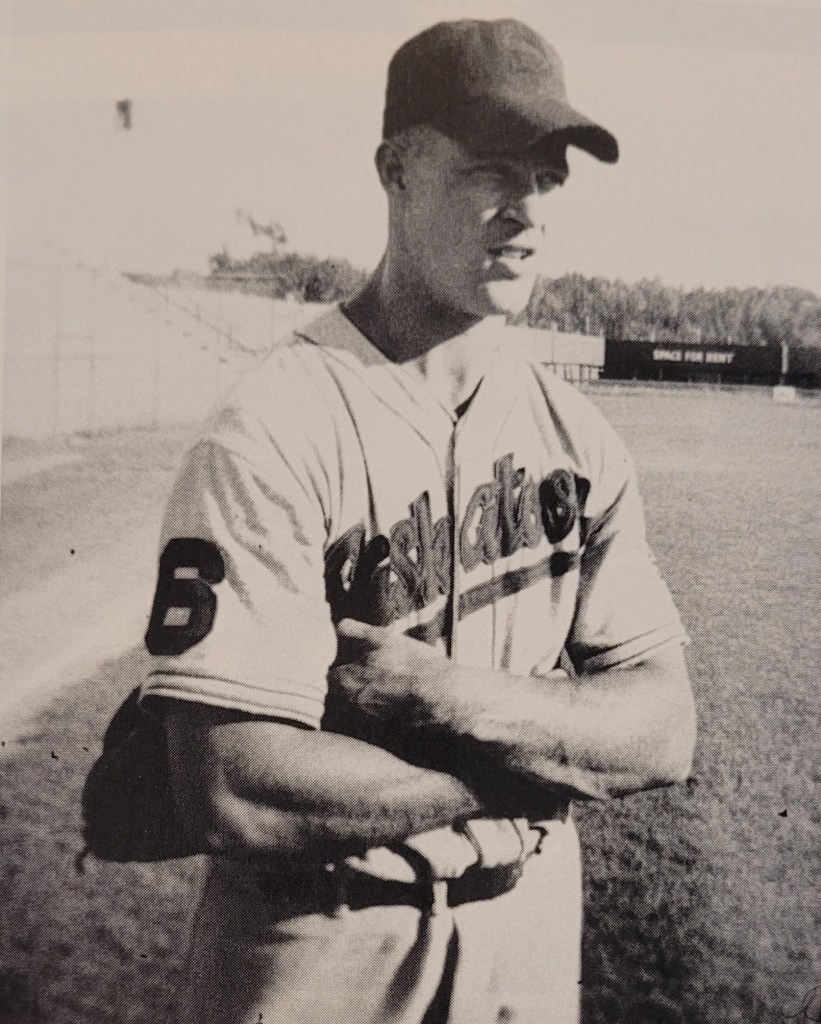
Despite the expectation he would stay away from the ballpark, Howe still threw on his spikes and ball cap that summer. The rugged athlete clobbered a three-run homer in the final game of the Prince Albert Kinsmen baseball tournament in late June. The 360-foot blast, which was witnessed by 5,000 fans, helped deliver a 9-1 victory for the Saskatoon Gems over the Regina Caps and generate $700 in tourney earnings for the team.
By this point, the Detroit Red Wings were getting nervous about Howe’s off-season athletic activities and general manager Jack Adams looked to put a halt to his time playing baseball.
“I might have played longer if not for an injury that drew some attention earlier in the summer,” said Howe in his 2014 book, Mr. Hockey: My Story.
“I was playing third base when I fielded a double-play ball, stepped on the bag, and fired it over to first for the out. As I made the play, the other team’s first baseman was charging in from second. Trying to break up the throw, he came in cleats up and spiked me. He probably learned it from watching Ty Cobb. His cleats broke through my skin and I ended up with blood poisoning. When the news reached Mr. Adams, that was all it took for him to snap into action.”
Howe would soon receive word from Adams to stop playing ball, but not before he exacted some revenge for the injury he incurred.
“The really annoying part of the whole thing was how far the guy had to run off the base path to get me. By the time I finished my throw to first, I was about six feet off the bag. I wouldn’t go so far as to say I’m vindictive, but it was a dirty slide and I felt like there was a score that needed to be settled,” wrote Howe in Mr. Hockey.
“In my next three at-bats I drag bunted each time until I flipped the script on him. It took three tries, but I finally put one squarely down the first base line. He charged in to field the ball and I ran straight up his leg with my cleats. Later, he told me that he should have just stood there and let me hit him the first time, because I was going to get him sooner or later. He was right about that. Tit for tat, I say.”
Howe described Adams as a controlling “old coot” who was able to “keep an eye on darn near everything” involving his hockey players.
“In the summer of 1952, I was playing in a tournament in Regina when I received a telegram from Mr. Adams that read, ‘Who’s going to pay your bills if you get hurt? I suggest you quit playing.’ It was a tough note to get,” recalled Howe in his autobiography.
“I didn’t want to entertain the thought of hanging up my cleats. At the same time, hockey was my livelihood and Mr. Adams was my boss, so I felt stuck. I had to respond, but I knew that once I did, my days on the diamond would be numbered. There was a tournament coming up in Kamsack, which is east of Saskatoon, that I wanted to play in, so I waited before getting back to Mr. Adams. I figured that, at the very least, some stalling could buy me a few more games.”
Added Howe: “When I finally replied, my telegram said, ‘Dear Jack Adams, are you serious?’ I figured it would take him a while to track me down, but unfortunately that’s not how it played out. When his return telegram found me in Kamsack, it read simply, ‘I am serious.’ Those three little words pretty much ended my semi-pro baseball career.”
He finished his Western Canada League campaign as the second best hitter on the circuit with a .393 batting average.
ROMANTIC AROUND BASEBALL
The Order of Canada recipient was well into his courtship of Colleen Joffa, who he met at Lucky Strike Lanes bowling alley in Detroit.
On April 15, 1953, the two got married and Gordie brought “Mrs. Hockey” home to Saskatoon for the summer following a honeymoon in Florida.
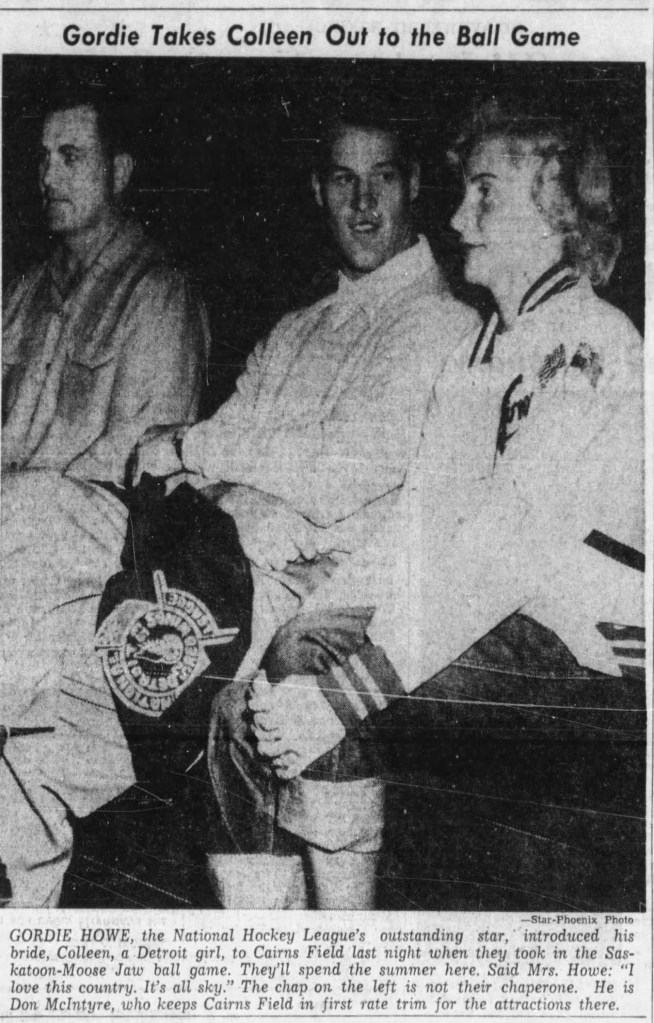
In late May, the newlyweds attended a ball game between the Gems and the Moose Jaw Maples. Star-Phoenix columnist Cam McKenzie caught up with the happy couple at the game and spoke with both of them.
“He didn’t say whether or not he would try baseball again, but intimated he might be confining his summer sports to golf and fishing,” wrote McKenzie.
“However, he visited the dressing room after the game and began swinging a bat.”
The Howes had plans to hit the links, spend time with Gordie’s parents and visit Waskesiu Lake during their time in Saskatchewan.
“Gordie has been telling me all about Waskesiu,” Colleen told McKenzie.
“I’m particularly interested to get out there, although I think this whole country is wonderful. It’s the first time I’ve been out here and I’m thrilled with everything – I think Saskatoon is a very pretty city.”
As he enjoyed his time with his wife, Howe also seized an opportunity to play baseball in July. When Jim Ryan, the everyday first baseman for the Gems, got injured, Howe agreed to suit up in defiance of Adams and the Red Wings.
Howe, who was the subject of trade rumours during that off-season, only filled in for a few games before retiring to Waskesiu Lake for some late-summer relaxation.
TIGER KING
That seemed to do it for Howe’s diamond days in Saskatoon, but baseball continued to be a part of his life moving forward.
In Detroit, Howe found a way to foster his love of baseball and get a few hacks in now and then.
“When Jack Adams ended my baseball career a few years earlier, I didn’t think there’d ever come a time when I didn’t miss it during the summer,” said Howe in Mr. Hockey.
“I still managed to find some time to sneak away for a bit of an off-season baseball fix. Back then, a lot of the professional athletes in Detroit knew each other. I became so friendly with some of the Tigers that they’d invite me out for batting practice. One time, I remember that (outfielder) Don Lund was hanging some fat pitches out over the plate during BP, and I turned some heads by sending a few into the upper deck of old Briggs Stadium.”
Howe continued: “The left-field stands where those balls landed were known as Greenberg Gardens, named after the legendary Hammerin’ Hank Greenberg, who deposited his share of balls up there. I like to think that a few of the pitches I hit were for all of the good baseball players in Saskatchewan who never got a chance to take a cut in a big league park.”

Howe met National Baseball Hall of Fame outfielder Al Kaline during one of his visits to Briggs Stadium and was immediately impressed by his abilities.
“This whip of a kid would fire a picture-perfect one-hopper back to the catcher every time. He ran like an antelope and had such a beautiful throwing motion that it was easy to see he was something special. Al’s talent was so great that I remember feeling a bit nervous when we were introduced, even though I was older and an established veteran in my own sport,” wrote Howe.
Howe and Kaline later became neighbours, good friends and they also went into business together for a brief period.
During his BP sessions, Howe wowed some of the Tigers, as well as members of the visiting teams. On one occasion, Cleveland manager Lou Boudreau offered him the opportunity to face major-league pitching, just to see what Mr. Hockey was really capable of with a bat.
WHAT IF?
It wasn’t the first time that Howe was scouted for his baseball skills.
“One year, I remember playing in a tournament in Indian Head, which is just east of Regina. The caliber of baseball was pretty good, especially for a small town in the middle of the Prairies. The tournament even attracted an All-Star team from the Negro leagues that made the trip up to Canada to play,” recounted Howe in Mr. Hockey.
“A scout for the New York Yankees – I think his name was Roy Taylor – was also there watching. I was seeing the ball well that weekend and in one game I even hit for the cycle …. Overall, I went 8 for 11, and I think the Yankees were looking at me as a potential prospect. Their interest quickly faded once they found out I was already playing professional hockey, but I was still flattered for the look. I don’t know if I would have had the goods to make the big leagues, but it’s not like I spent much time over the years thinking about what-ifs. Hockey was so good to me I don’t have much room to harbor regrets about another sport. Suffice to say that baseball’s a wonderful game. I loved playing it right up until the day Mr. Adams put a stop to it.”
Eric Olsen met Howe in Vancouver in 2009 and the two discussed the competing interests that the Yankees and Red Wings had in the rough-and-tumble athlete.
“Yes, the Bronx Bombers wanted the tough, athletic farm boy from Saskatoon to join their farm system. He told us he very nearly did just that, except the Detroit Red Wings upped the ante and offered him a signing bonus,” Olsen said in an article in the Coast Reporter news publication.
The “signing bonus” in this case ended up being a team jacket, which the Red Wings eventually handed over to secure arguably the greatest hockey player ever.
“If the New York Yankees had matched the offer, and maybe thrown in a hat to go with the jacket, would we be talking about the life and career of one of the best baseball players of all time? Maybe. I certainly wouldn’t bet against it. Not against Gordie Howe,” mused Olsen.
“Imagine the powerhouse Yankees of the early 1950s with Gordie Howe playing alongside Yogi Berra, Mickey Mantle, Whitey Ford, Hank Bauer, Phil Rizzuto, and Joe DiMaggio at the end of his career. Wow. We will never know how great he could have become playing with the boys of summer, but I believe he would have been the same hard-nosed superstar that he was in hockey. His off the charts physical strength, mental toughness, and competitiveness along with his athletic skills would have made him as fearsome an opponent in baseball as he was in hockey. And heaven help the pitcher who threw a beanball at him!”
Former Chicago Blackhawk left winger Dennis Hull shared another story with National Post reporter Cam Cole in 2013 that spoke to Howe’s natural athletic abilities across several sports.
“I played against him, of course, but one day in the summer, we were playing golf in Halifax. We were the first ones out, just after dawn, nice course, no practice balls, just get up and hit it. He shoots 68,” said Hull.
“So I said: ‘Gordie, you’re the greatest hockey player of all time, you just shot 68 and you could have played major league baseball. It doesn’t seem fair.’ He said, ‘You should see me bowl.'”
THE ARTFUL DODGER
While Howe never did bring fans to their feet at Yankee Stadium, he and Colleen were able to leave one pinstriped legend speechless.
The couple shared a story in the introduction of their book and … Howe! that recounted a time they were at a charity event in Phoenix, rubbing shoulders with a number of sports stars.
A silent auction item up for grabs was artwork of Joe DiMaggio that was painted by Curt Flood.
“It was a great painting. I had no idea that Curt, a great outfielder like Joe, could also paint. I knew he had changed the laws of baseball by challenging free agency. And Joe DiMaggio is just, well, he’s Joe DiMaggio. I wanted to bid on this portrait, but I figured there wasn’t enough money in the world to buy it. It was just beautiful. I told this Colleen, and she said, ‘Well, I’m going to bid on it anyway,'” said Gordie.
“I had talked to Joe at lunch, and he said he really liked the painting too, and wanted to bid on it himself, but he thought it would look funny if he did. If he bid too low, he would look cheap. And if he got it, it might seem strange that he bought his own portrait.”
Little did Gordie or Joltin’ Joe realize that Colleen was about to work some magic.
“At the auction that night, they announced that, ‘The winner is … Colleen Howe,'” remembered Gordie.
“She had told me when she put in her bid, ‘If I win we’ll have to get Joe to sign it.’ So, she called on Joe to come up to the podium, and I thought she would have him sign it there for us. So when Joe goes to center stage, and Colleen says to the crowd, ‘This is such a magnificent picture, and Gordie and I would love to have it in our home, but I think it should belong to only one person.’ Then she gave it to Joe.”
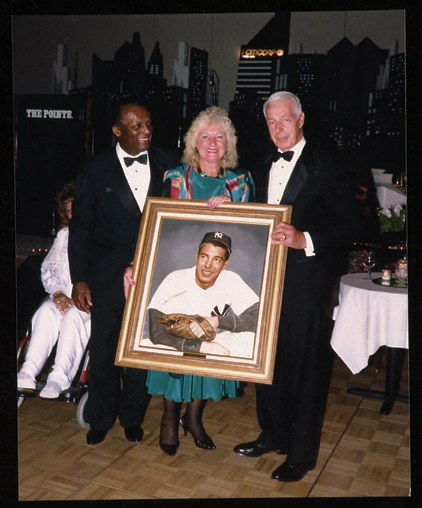
The move shocked both sporting greats.
“It was a great thing to do, but I went bilingual. ‘What the hell did she do that for?’ It was funny, because I really wanted it. I can see that painting now. And she looked me right in the eye and said, ‘Don’t you realize that the art of giving is to give something you truly would like to keep for yourself.’ And I said, ‘Yeah, and boy, did we give,'” said Howe.
“Joe was stunned and surprised. It really wiped him out. He said nothing like that had ever happened to him. But that’s Colleen, she does those kinds of things.”
Colleen passed away in 2009, at the age of 76, and Gordie died in 2016 when he was 88 years old.
The Gordie Howe Sports Complex in Saskatoon is a multi-sport facility that includes the new Cairns Field, which is the city’s largest ballpark and home to the Saskatoon Berries of the Western Canadian Baseball League (WCBL).



 Tales of Baseball
One thought on “Howe-To Guide to Baseball”