
J.P. Antonacci
Arleene Noga was a mild-mannered baseball lifer with one pet peeve – poor fundamentals.
The former All-American Girls Professional Baseball League (AAGPBL) star from Ogema, Sask., could not abide seeing players lollygag a throw or casually scoop a grounder.
And Noga – known in her playing days for her speed on the bases and stellar glovework at third base – did not spare the pros from Toronto if she noticed something objectionable on her television screen at home in Regina.
“She would critique the players,” Noga’s daughter, Carol Lee Scott, said with a smile.
“She’d watch the Blue Jays games and complain about the batters,” added Carol Lee’s husband, Lloyd Scott. “I can’t remember which batter, but she said, ‘There’s no way he’s going to hit the ball standing like that.’”
Noga, who died in 2017 at age 93, knew what she was talking about.
Young Arleene Johnson – her teammates called her “Johnnie” – was scouted out of Regina as a Senior A softball player and signed with Fort Wayne of the AAGPBL, playing 15 games for the Daisies in 1945 before a trade to the expansion Muskegon Lassies the following year.
In Michigan, Noga set a league record at the hot corner with a .942 fielding percentage, helping the Lassies win the 1947 pennant.
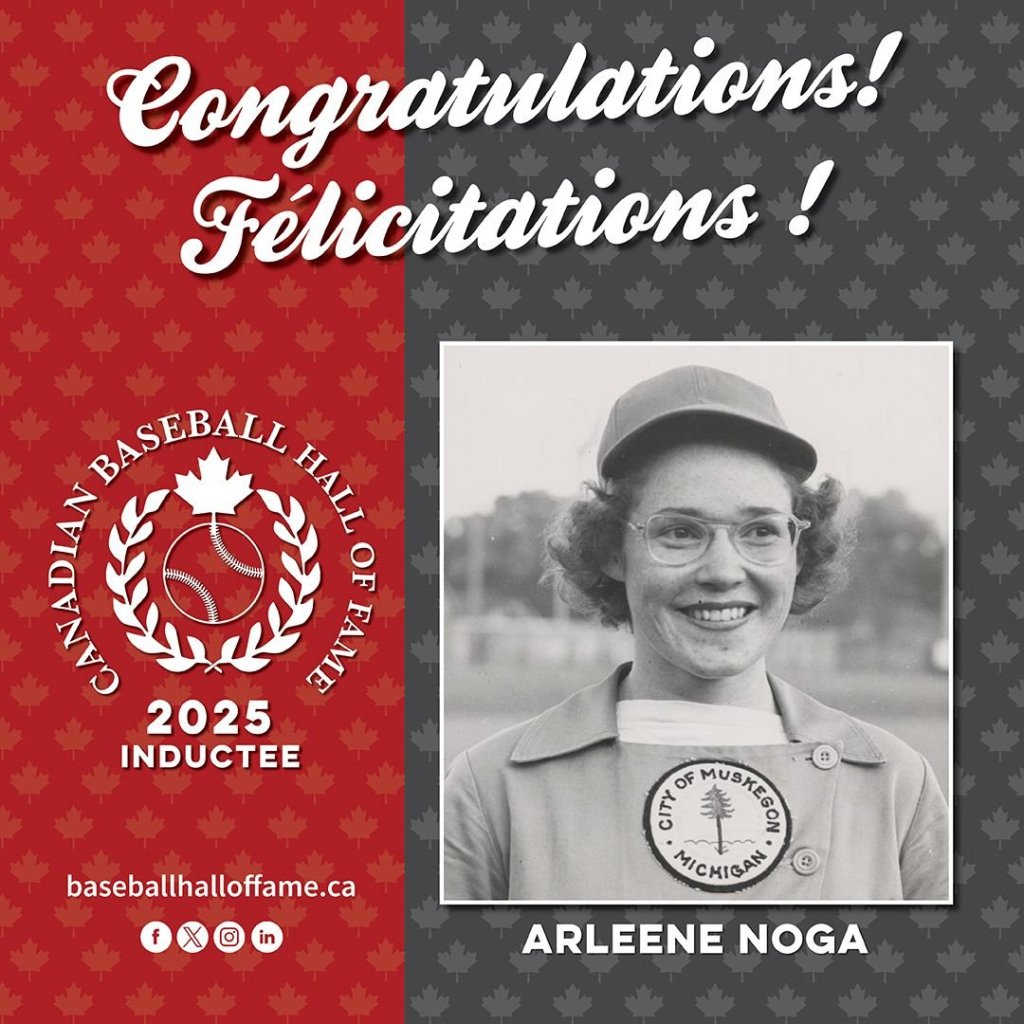
Known as the “Iron Lady” for playing in over 300 consecutive games, Noga left the AAGPBL after the 1948 season. The 5-foot-4 offensive catalyst ended her tenure in the fabled wartime league ranked in the top 10 among Canadian players in at-bats, hits, runs, RBIs and stolen bases.
After departing the professional ranks, Noga married and had two children while carving out a long career in Saskatchewan’s civil service. But baseball never let her go. She played amateur softball in her home province for 30 years, winning nine provincial championships and five Western Canada titles while twice being named league MVP.
She eventually shifted into coaching, which is how her daughter best remembers her on the ballfield.
“Very focused. I think she coached in a gentle way,” Carol Lee Scott recalled. “She wouldn’t yell at them and lose their mind. More of a corrective approach. She’d demonstrate rather than just saying, ‘You’re not doing that right.’”
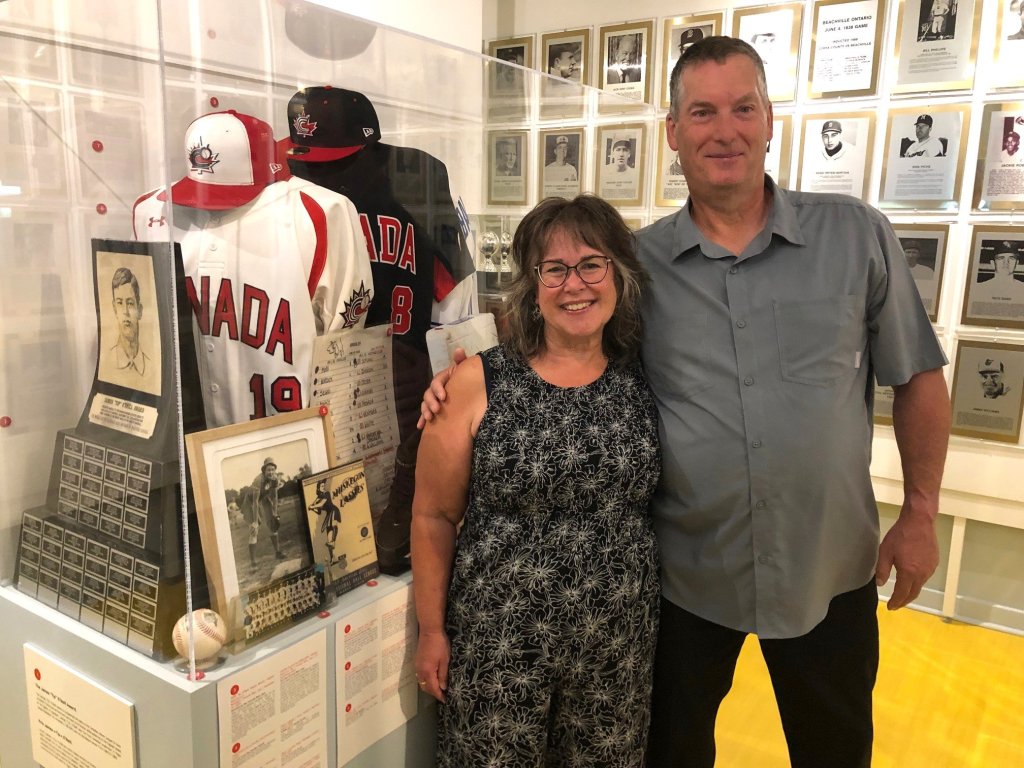
Scott’s husband said Noga was “very professional” and had exacting standards.
“She liked things done right,” Lloyd Scott said. “So if you were going to do something, do it right.”
Motivated by what her daughter called “a passion for the game,” Noga dedicated herself to boosting women’s baseball across the country. She was a regular speaker at school assemblies, banquets and spring workouts, and she coached girls at tournaments and baseball clinics in Saskatchewan and Nova Scotia.
“She never turned down an opportunity to appear at a clinic,” Carol Lee Scott said. “Mom just did it for the love of the sport.”
It’s unlikely any of the young ballplayers Noga mentored realized they were learning from a trailblazing professional player. Her own kids had no idea about their mother’s wartime exploits on the diamond until Hollywood came calling.
“It was in the ‘80s that her and some other former players got together and wanted to do something to preserve the league so that it wouldn’t get lost in history and forgotten about,” Carol Lee Scott said.
Noga helped form the AAGPBL Players Association and was on the board of directors for 12 years, serving as a spokesperson for the league’s 68 Canadian alumni.
So when director Penny Marshall went looking for technical advisors for her 1992 movie “A League of Their Own,” Noga got the call, giving actor Rosie O’Donnell tips on playing the infield and teaching Madonna how to slide.
Noga also grabbed her glove and appeared as an extra in the film alongside 64 other original AAGPBL members, which opened Scott’s eyes to her mother’s early career.
“I really didn’t know much about it until the movie came out. That was my moment of really starting to understand the significance of her playing professionally,” Scott said.
“I don’t know that she even referred to it as being professional ball. It was just what she did. She loved it.”
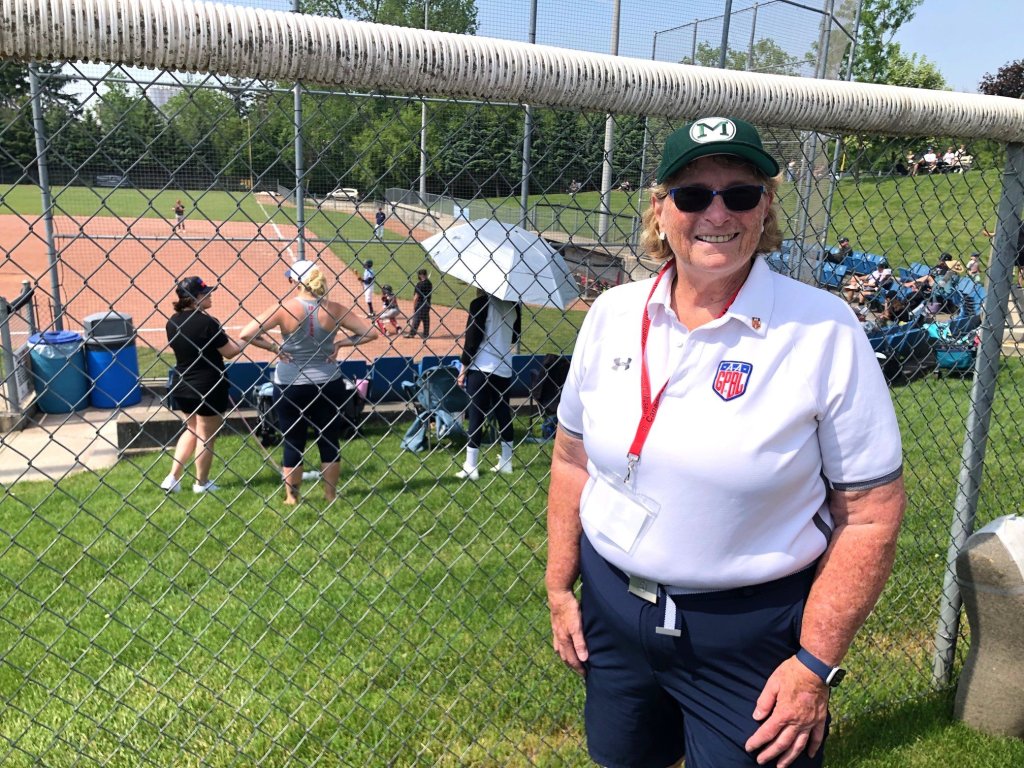
That modesty is typical of AAGPBL alumni, said Carol Sheldon, current vice president of the AAGPBL Players Association.
Sheldon said her softball coach in Detroit, a former AAGPBL player, “literally took her memorabilia, put it in suitcases and stuck it in the attic, and didn’t talk about it.”
“A lot of them, they’ll tell you, ‘We didn’t realize what we were doing. We just wanted to play ball,’” said Sheldon, who traveled to St. Marys, Ont., from her native Michigan for Noga’s induction into the Canadian Baseball Hall of Fame on June 7.
“And then as time went on, they realized they were breaking barriers. And not just in the sports world.”
It was rare for women in the 1940s to leave their homes and travel for work, Sheldon noted. The league connected women from across the United States, Canada and Cuba who would otherwise never have met but became “fast friends” thanks to playing ball together.
The war changed the face of pro sports – temporarily. Once the men returned from the front, many of the women in the AAGPBL quietly left the diamond and carried on with their lives.
“They just packed it away and didn’t talk about it,” Sheldon said. “Until the movie came out.”
“A League of Their Own” brought long-overdue acclaim for the groundbreaking athletes, and their gob-smacked children “became huge supporters of what their mothers did,” Sheldon said.
Having Noga and dozens more alumni appear in the film rekindled many old friendships, Sheldon added.
“It was like a rebirth for these ladies,” she said. “It was so cool to see them interact with each other, because it was like these friendships that had disappeared for a while just immediately reignited. You could just see them knock 20 years off their life.”
Scott said her mother liked the movie, which depicted how league organizers forced players to attend charm school and play in skirts.
“She said it was actually quite close to what they experienced playing, embellished for entertainment purposes,” Scott said. “Learning to be that ballplayer on the field and yet present as a lady.”
Players may not have talked much about their time in the AAGPBL, but the experience was life-changing for many. Some alumni used the money they made playing ball to become the first people in their families to go to college. Former players went on to careers in law, medicine, aviation and education, Sheldon said, while AAGBPL alumni helped form the LPGA and advance the cause of organized women’s sports in the United States and Canada.
Sheldon remembered meeting Noga through the players association, describing her as “a very quiet, reserved woman.”
“Very unassuming. A very grandmother-like kind of person,” Sheldon said with a laugh.
On Saturday, Noga became the second AAGPBL alumna elected to the Canadian ball hall as an individual athlete, following Helen (Callaghan) Candaele in 2021. All Canadian women who played in the league over its 12-year existence from 1943 to 1954 were inducted en masse in 1998.
“It helps to bring women’s baseball to forefront and let people know that we play baseball – not softball, not fastball. Baseball,” Sheldon said.
“And then of course with Noga going in and Callaghan going in, it shows the history. Because most people don’t realize when baseball was invented in the 1860s, women were playing then.”
Were Noga at the hall of fame ceremony, she would likely have blushed at all the accolades, Carol Lee Scott said.
“Very humble. She never sought the attention. It came to her, but she was never boastful or anything,” she said.
“I’m proud of her. Very proud of her accomplishments and what she continued to do throughout her life.”
As for what motivation people should take from Noga’s story, Carol Lee took a moment to reflect on her mother’s legacy as a trailblazing player, dedicated coach, and “lifelong ball enthusiast.”
“Follow that dream,” Scott said. “Don’t give up on your passions. And do what you’re passionate about.”



 Tales of Baseball