
By ROBYN JENSEN
Special to Saskatchewan Dugout Stories
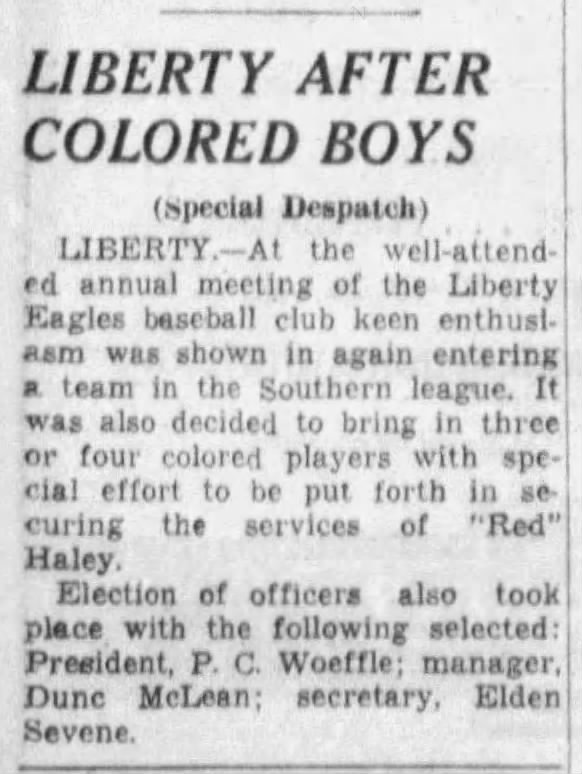
“It was decided to bring in three or four colored players with special effort to be put forth in securing the services of ‘Red’ Haley.”
A small notice in the local paper. No debate recorded. No controversy explained. Just an off-season meeting and a plan for the summer ball club.
The words read differently today than they likely did then, what we might interpret as a racial decision was simply baseball to them. Liberty manager Dunc McLean wasn’t thinking about race relations or history. He was trying to build a ball club that could win.
I began researching African-descent players in Saskatchewan through the Indian Head Rockets and, like most people, first followed their stories south into the Negro Leagues. That history matters. But once they reached prairie teams, the conversation changed. Here, they were talked about as ballplayers, judged by how they played.
At first, they drew curiosity. For many prairie fans, it was the first time they had seen an African-descent ballplayer in person, and people came as much to look as to watch. But the summer season has a way of settling things. Once they were here a while, the attention shifted to the game itself. They played alongside the local boys, and the 1940 newspapers wrote about them the same way they wrote about everyone else, by position, by hits, and by what they did on the field.
When players like Granville Anthony “Red” Haley arrived, they didn’t enter a league waiting to be integrated; they entered a community and town that wanted to win. Fans argued batting order, not belonging.
Barnstorming teams often introduced prairie communities to this talent, and recruitment could be as simple as walking up after the game and asking a player to play for them the next season. Once he did, he wasn’t visiting anymore; he was part of the team.
This wasn’t because prejudice didn’t exist. It did. But distance mattered. Many farms didn’t have electricity until the 1950s, and the outside world arrived slowly by telegraph and newspaper. Here, the story wasn’t who he was; it was how he played.
They were simply ours.
And in the spring of 1940, one of them was “Red” Haley.
Except he wasn’t new to Liberty at all.
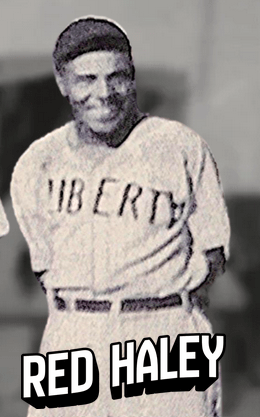
Red Haley didn’t arrive in Liberty as an unknown ballplayer drifting north for work. His reputation had already travelled the prairie circuit years earlier, particularly through North Dakota’s town teams (most notably Dunseith Giants) in the mid-1930s, where communities were already fielding mixed rosters simply to compete.
Years later, catcher Ted “Double Duty” Radcliffe remembered those Dakota teams differently than the leagues he had known elsewhere. As one observer recalled, there was “more ignorance than bigotry” (Castle). People came to the ballpark simply to see good players and a winning team.
The reception Haley found in Liberty would look familiar.
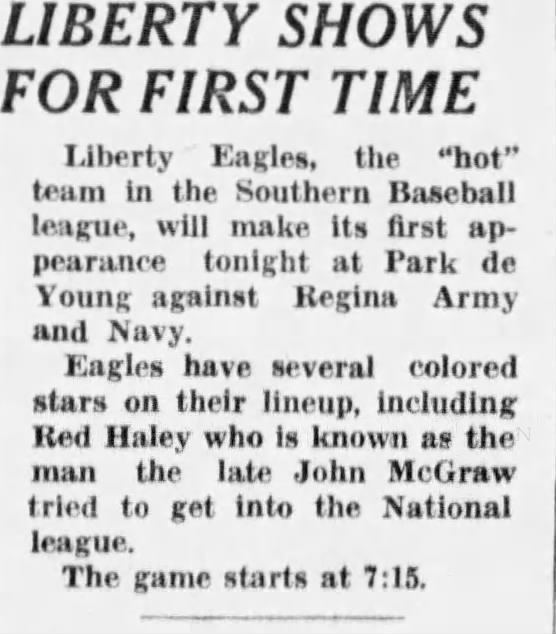
By the time Haley first appeared with the Liberty club in 1939, the newspapers already treated him as a player worth naming. One report even noted major-league interest connected to him, unusual attention for a small-town lineup, and a sign that Liberty wasn’t taking a chance on an unknown pickup. He was a draw.
The next summer, the introductions were no longer necessary.
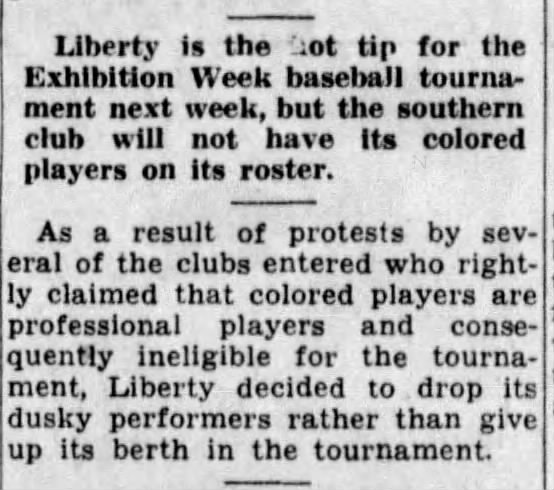
The reaction that followed revealed just as much. When Liberty entered tournament play, protests came not over who the players were, but what they were considered. Opposing clubs argued that the African-descent players were professionals and therefore ineligible.
(Even major-league material perhaps) Liberty chose to remove them rather than withdraw from the competition.
Haley didn’t come alone. Three other African-decent players suited up for Liberty that summer as well. (Lefty Johnson, Edward Brown, and Britt Ward) Their origin stories are harder to trace; their names surface briefly in box scores and then fade, but they were part of the club just the same.
By the time Liberty pursued Haley again for 1940, they weren’t experimenting or making a statement. They were bringing back a player whose reputation had already been established in a baseball culture that understood exactly what he could do.
And in 1940, they saw it.
The previous summer had introduced Red Haley to the league. The next one made him impossible to ignore.
As the weeks passed, his name settled into the standings as naturally as it did the lineup. By midseason, he was hitting .402, piling up 33 hits to tie the league lead and driving balls into the alleys often enough to finish with nine doubles, along with triples and home runs scattered through the schedule. The numbers explained why innings seemed to run longer when he came up; rallies rarely ended with him.
In Regina, a young pitcher earned a mention for striking him out twice in one afternoon, a detail worth printing precisely because it didn’t happen often (“Along the Sport Byways”). Most days, Haley was the one forcing adjustments: outfielders shading deeper, infielders shifting a step, pitchers working the corners but still having to come to him.
Tournament crowds followed the club that summer. At Nipawin, thousands gathered around the grounds, watching Liberty move through games from noon until evening, the team carrying four African-descent players and drawing attention for the quality of play rather than novelty (“Liberty Takes Money”). The Eagles won the final, another entry in a season that kept extending itself one more inning at a time.
Back in league play, the standings separated and Liberty stayed near the top, built on steady pitching and timely hitting, Haley usually somewhere in the middle of it. When sportswriters later assembled their all-star selections, his name appeared at second base, not highlighted, not explained, simply listed among the season’s best (“Pick Your Star!”).
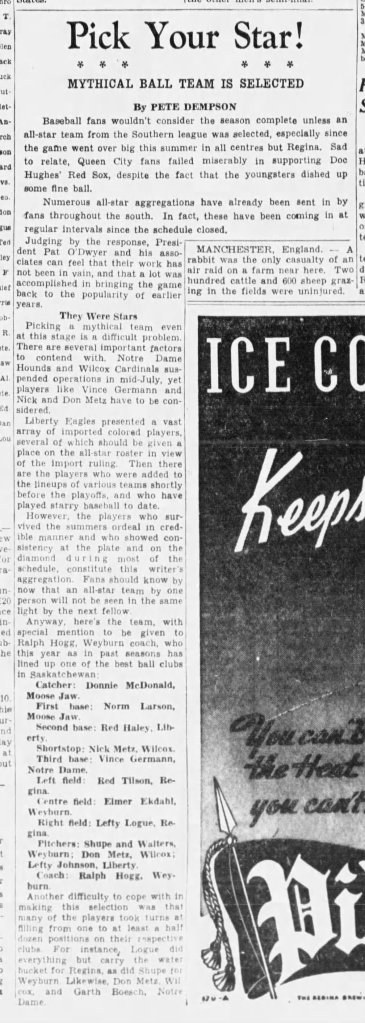
By then, the introductions were long over. He was just part of the lineup people expected to see.
In the spring of 1940, a newspaper note recorded Liberty’s effort to secure Red Haley’s services. It read like a transaction, a lineup decision for the coming season.
By autumn, no one needed the explanation anymore. The games had already done that.
He wasn’t remembered as a first, or a statement, or a visitor passing through.
He was remembered as Liberty’s ballplayer.
Red Haley: Career Overview
1928: Chicago American Giants
1928: Birmingham Black Barons
1929–1932: Gilkerson’s Union Giants
1933: Kansas City Monarchs
1933: Pollock’s Cuban Stars
1935: Bismarck Churchills, North Dakota
1937–1938: Dunseith Giants (Barnstorming team), North Dakota
1939–1940: Liberty Eagles, Saskatchewan
Works Cited & Additional References
“Along the Sport Byways.” The Leader-Post, 16 July 1940.
Castle, George. “North Dakota Baseball Way Ahead of Its Time with 1930s Integrated Teams, Including ‘Duty.’” Chicago Baseball Museum, www.chicagobaseballmuseum.org.
“Dunseith Colored Nine to Play Here on Sunday, Monday.” The Bismarck Tribune, 25 May 1937, p. 6.
“Dunseith to Sponsor Negro Ball Team Again.” The Bismarck Tribune, 20 Apr. 1938, p. 6.
“Dunseith Giants Trim Maroons in Double Bill.” Star-Phoenix (Saskatoon), 8 Aug. 1938, p. 11.
Jensen, Robyn. “A Baseball, A Story, and the Liberty Eagles of 1940.” Home Runs & Dirt Roads, 10 Aug. 2025, homerunsdirtroads.ca/2025/08/10/a-baseball-a-story-and-the-liberty-eagles-of-1940/.
Haley, Red. Seamheads Negro Leagues Database, www.seamheads.com/NegroLgs/player.php?playerID=haley01red
“Liberty Takes Money.” The Leader-Post, 24 June 1940.
Liberty team photo, 1940. Saskatchewan Baseball Hall of Fame
Mah, Jay-Dell, and Rick Necker. “1940 Southern League Statistics.” At the Plate, www.attheplate.com/wcbl/1940_2.html.
“Pick Your Star! Mythical Ball Team Is Selected.” The Leader-Post, 10 Aug. 1940.
Robyn Jensen Bio

Robyn Jensen is a Saskatchewan baseball historian and curator at the Saskatchewan Sports Hall of Fame. She holds a Master of Arts in Media and Artistic Research and spends most of her time chasing prairie box scores, forgotten players, and the stories hiding between them. Through her Home Runs & Dirt Roads project (homerunsdirtroads.ca), she shares the history of local teams and the people who made the game matter in small-town diamonds across the prairies.



 Tales of Baseball