It started as a simple trip to the United States in search of a solid roster for baseball tournaments in Saskatchewan.
Little did Jim Robison and his contingent know, who they recruited would forever change the landscape of baseball in his province and inspire future generations of ballplayers.
After several years of hosting some of the biggest tournaments in Canada, the Indian Head mayor wanted to field a team capable of winning it all as well.
“It sounds screwy but they do it up big financially up in central western Canada,” wrote Peter Lightner in the Wichita Eagle on May 19, 1950. “The five-man delegation here to find baseball talent for their tournament season up in Saskatchewan cites some figures to make us wonder if they use gold mines for club houses up that way.”
They found the Jacksonville Eagles, a Negro League team led by player/manager “Big Jim” Williams, and the Indian Head Rockets were born.
While they only existed for five years, the Rockets left behind a million memories and a legacy that is still felt in the community to this day.
CANADA’S GREATEST BALL TOURNEY
Located about 70 kilometres east of Regina along the Trans-Canada Highway, Indian Head was one of the many stops on a circuit of baseball tournaments every summer.
Players from across Western Canada and the northern United States would converge on each of the communities in hopes of splitting some of the hefty paydays that a win would provide.
Small communities of just a few hundred would balloon to the thousands over the course of a few days as fans flocked to take in the exceptional talent.
Such was the case in Indian Head, where it was billed as “Canada’s Greatest Baseball Tournament” in 1949.
“A town of about 1,500 people and up to 30,000 people would come to this community to watch baseball,” Indian Head Museum curator Robyn Jensen told Alberta Dugout Stories: The Podcast. “It was just unbelievable – like, where did they all come from?”
In an effort to find a team of their own, Robison and other members of the Rockets organization started conversations with Ray Dumont of the National Baseball Congress.
Along with the prize money from each event, they were willing to pay players anywhere between $200 and $350 per month, depending on their experience.
TREATED LIKE HEROES
The new edition of the Indian Head Rockets quickly turned heads with their talent and swagger.
The club not only won its home tournament, but came with a record of 66 wins, 20 losses and five ties.
Off the field, Jensen says they were treated “like kings,” as they were billeted in renovated apartments above the Dominion Café and provided meals.
“Baseball put these players on a pedestal,” she said. “When you come into a community and they’re representing you, you’re going to treat them well – you’re going to treat them like heroes.”
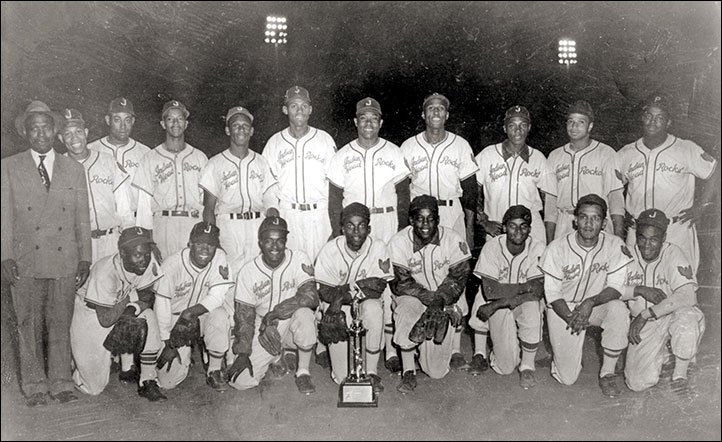
They were also part of the community, taking part in dances and were not subjected to segregated seating in restaurants like they were in the U.S.
“Curly Williams tells the story about how he would travel with his teammates and he would have to sit in the kitchen to eat his meals while his ball players (white teammates) would sit in the restaurant area and eat,” said Jensen. “He would cry about it because he felt like it was so demeaning for him.”
While Williams was coming up to Canada with his family to play for the Lloydminster Meridians, she says he wasn’t allowed to buy diapers for his kids because he was black and they wouldn’t allow it.
That changed when they crossed the border, and word started to spread about how the team was treated.
CASH-STRAPPED ALL-STARS
The following summer would prove to be even better on the field for the Rockets.
Featuring a roster with former Negro Leagues star Chet Brewer and Tom Alston, who was the first black player to suit up for the St. Louis Cardinals, they were nearly unstoppable – at one point, they won 22-straight games.
The Rockets were able to capture tournament wins in Prince Albert, Foam Lake and Tisdale, but weren’t able to replicate it during their home tournament as they lost to Regina.
Despite the improvements and success, the losses were starting to mount off the field.
The team ran deficits each season even though they had great attendance numbers in Saskatchewan and Alberta as well as strong support from the community.
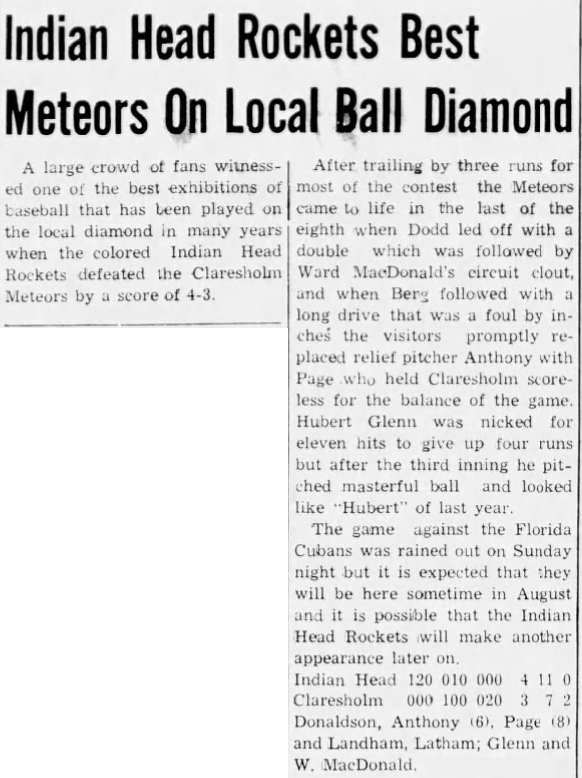
The challenges continued in 1952, then the Rockets enlisted the services of another Negro League team, the Florida Cubans, for the 1953 and 1954 seasons.
The financial losses mounted and when no touring or professional clubs were allowed entry in 1955, the Indian Head Rockets were no more.
IMPACTING A COMMUNITY
The story of the Rockets has been told in a number of ways through baseball historians like JD Mah and Max Weder.
When Jensen and her family settled in Indian Head about 20 years ago, she didn’t hear the story of the Rockets, when her daughter, then a summer student at the museum, brought the story home to share.
From there, she took a vested interest in learning more about the team, as well as other ballplayers from that era to better understand the culture of the time.
Each new piece of information sent Jensen down another rabbit hole as she tried to understand how each athlete ended up in the community.
More importantly, she wanted to find out how her town was impacted by this team of star ball players.
“These men were seen as heroes to the kids,” said Jensen, who also started Home Runs & Dirt Roads to honour the team.
“They would watch them and want to be just like them.”
Over the years, stories have been passed down from generation to generation, undoubtedly giving young baseball players a hope that they, too, could one day chase their own diamond dreams.
DOCUMENTING THE LEGACY
Even today, Jensen says people come into the museum and are awestruck that Indian Head was home to the trailblazing team.
Jensen has numerous stories to share, but one that always sticks out in her mind is when a young boy of African-Canadian descent came in with his mother, not really paying attention to anything until he came to the Rockets display, fixating on one of the players: Pumpsie Green.
“He stops and goes, ‘Mom, mom, come here!’” she remembered. “She’s like, ‘What?’ and he says, “He has the same name I do (Elijah) and he looks like me.”
It was a moment Jensen says made her, and the boy’s mother, cry.
She says it reinforced the importance of her work and the understanding that the stories of the past need to be told for future generations to understand where we’ve been but to also be inspired.
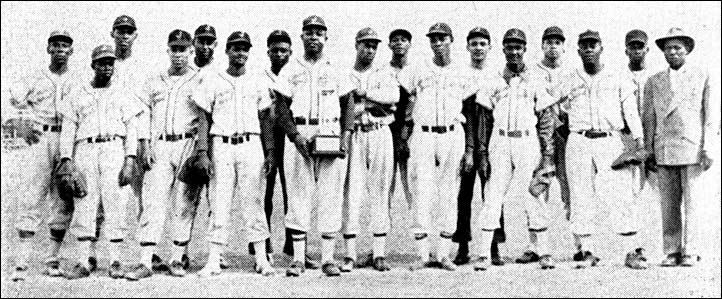
2025 marks the 75th anniversary of the Rockets, and Jensen is taking another step in her storytelling journey as she is working on the development of special Rockets baseball cards.
With only two surviving members of the team – Nat Bates and Willie Reed – left to tell first-hand accounts of the Indian Head squad, she is doing everything she can to document their stories and spread the tales far and wide.
“My way of honouring them is just to learn about them and share their stories so that they can continue to inspire people as they continue to inspire me,” she said. “Every time I learn something new about them, I’m just in awe.”
It’s a feeling many people have when they read the stories of the Indian Head Rockets.